
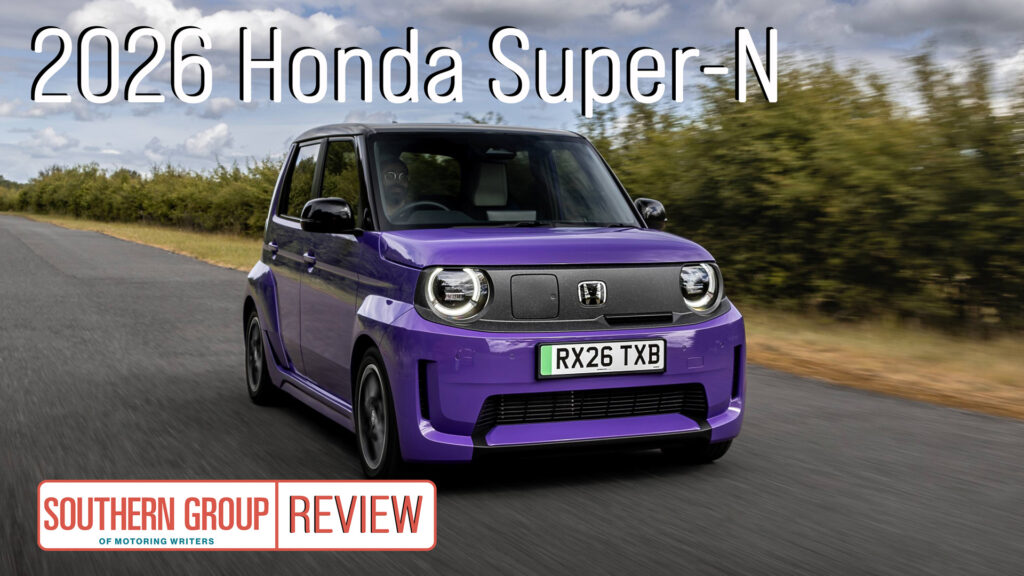
Honda has not had a huge success story when it comes to selling EVs in the UK.
It kick-started its electrification strategy in 2020 with the E supermini, though its high price tag and diminutive range meant Honda axed it from our shores in 2023.
Then the e:Ny1 arrived to take on the electric SUV market and was flawed due to its average driving experience, mediocre range and rather lacklustre appeal before being pulled from sale earlier this year.
So, Honda has had another crack at the EV sector with the Super-N – a compact electric city car that’s going up against the new Renault Twingo and BYD Dolphin Surf. Will it be third time lucky or another sales flop? Let’s find out.
Updates
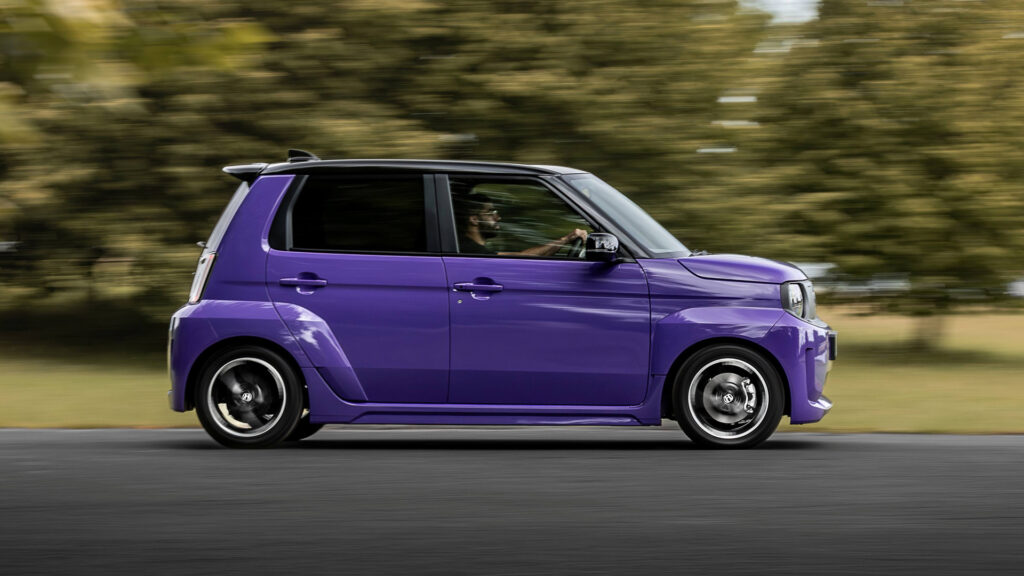
The Super-N may look like a new car, but it’s actually based on Honda’s N-One e: electric kei car – a specific category of micro car in Japan that benefits drivers with cheaper road tax, lower insurance rates and registration fees.
To make the Super-N more suitable for Britain’s roads, Honda has widened the car’s track, tuned the suspension and flared the wheel arches to give it a sportier appeal.
Lots of the exterior and interior design has been inspired by the 1980s Honda City Turbo II, plus the car is fitted with a ‘Boost’ mode function, which provides more power and an artificial engine note with a simulated gearbox that can be controlled via the regenerative braking paddles on the steering wheel.
Engines and transmission
Underneath its skin, the Super-N comes with one powertrain and that’s a dinky 29.6kWh battery pack mated to a single electric motor.
In standard form it produces 63bhp and 162Nm of torque, while the dash to 60mph comes round in 14.3 seconds and the car tops out at 83mph. However, when Boost mode is applied, power jumps to 93bhp and the 0-60mph time drops to 10 seconds.
In terms of range, Honda claims the Super-N can travel up to 128 miles between charges – that’s 35 miles less than what you get on the new Renault Twingo – and has a maximum DC charging rate of just 50kW, allowing a 10 to 80 per cent top-up to be completed in 28 minutes.
Driving experience
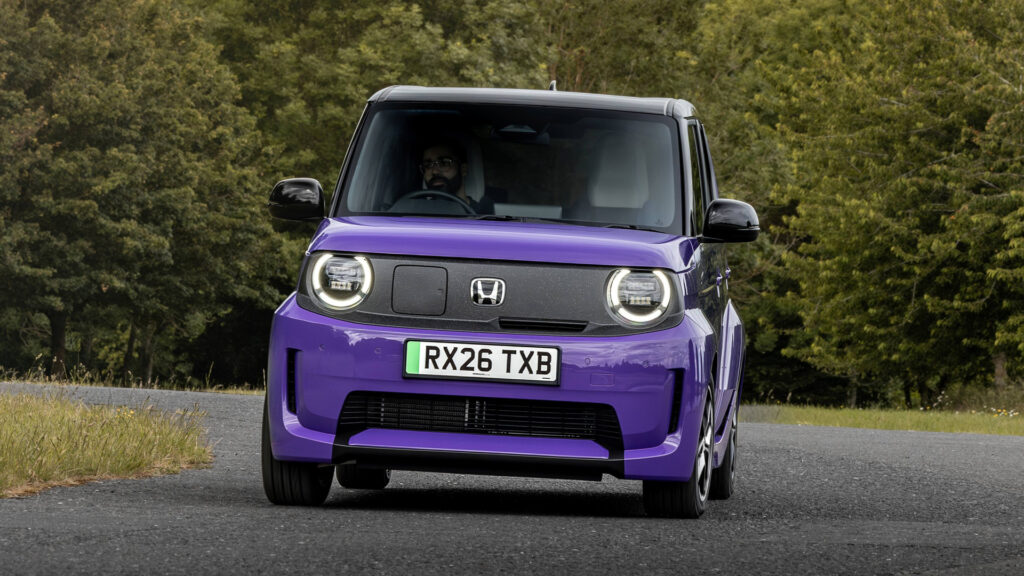
The Honda Super-N is in its element around town thanks to its tiny proportions, which help when parking and fitting through tight gaps.
The steering wheel-mounted paddles allow you to adjust the level of regenerative braking, while ‘City’ mode activates the car’s one-pedal drive feature, which can bring the car to a complete stop from the driver lifting off the accelerator pedal.
For an EV, the Super-N is very light, weighing in at just 1,097kg, making it one of the lightest cars in its class and it shows on a twisty road. The responsive steering, sharp handling and limited body lean make it a lot of fun, and the steering wheel-mounted purple ‘Boost’ button adds even more personality, turning the regenerative braking paddles become into simulated gearbox with a synthetic engine note that is pumped through the car’s speakers. Furthermore, this drive mode unlocks an extra 30bhp and gives the car a much more sprightly feel.
Over the duration of 260 miles’ worth of driving, the Super-N averaged 4.4 miles per kWh, which works out to be a real-world range of 130 miles – that’s two miles more than Honda’s officially claimed WLTP figure.
Looks
If you’re into your Japanese cars, you’ll notice that the Super-N shares a lot of its body panels with the N-One kei car.
It has a very boxy silhouette and slab-sided profile, while the front end houses circular headlights wrapped in a cylindrical front panel.
For design inspiration, the Super-N uses lots of styling cues from the 1980s Honda City Turbo II hot hatchback with its flared wheel arches, sports bumpers, front air intake, rear spoiler and fake rear wheel arch diffusers.
We love how this little car looks, and it certainly creates a lot of attention out on the road, especially in our test car’s Boost Violet Pearl paintwork.
Interior and practicality
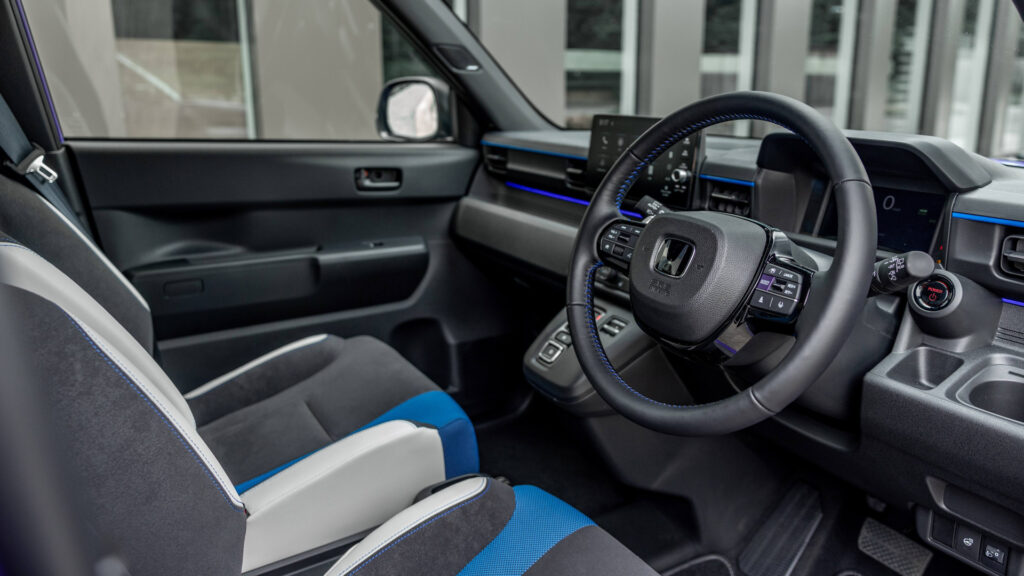
Despite the Super-N’s miniature dimensions, the cabin feels Tardis-like inside.
The dashboard layout is simple with lots of physical buttons, and the compact climate control display adds to the car’s cutesy charm. Interior quality isn’t the best with lots of hard, brittle plastics, but everything feels sturdy and built to last.
As standard, the Super-N comes with chunky sports seats, which are another nod to the City Turbo II, and are made from old Honda factory worker uniforms.
In terms of storage, there are front door bins that can accommodate a water bottle, a centre console tray, two cup holders, a small glovebox and a shelf on the dashboard.
Getting into the back is made easier thanks to the 90-degree-opening rear doors, though there are just two seatbelts making the Super-N a strict four-seater. Space isn’t an issue due to the tall roofline offering plenty of headroom for adults, plus there’s a surprising amount of knee, leg and shoulder space, and the rear seats can recline to make it even more comfortable.
The Super-N is fitted with Honda’s famous ‘Magic Seats,’ where the rear-seat bases flip up and lock into place to allow taller items such as plants or even a foldable bicycle to be carried in the back.
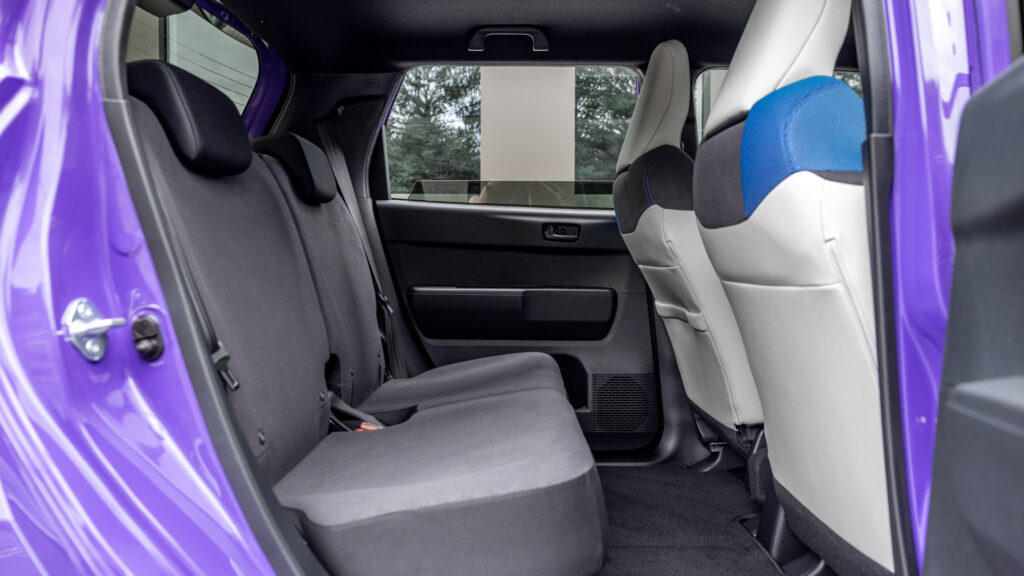
Boot space isn’t the best, measuring just 162 litres, though the 50:50 split-folding rear seats do provide a completely flat load bay, extending the capacity to 967 litres. Additionally, the extremely low load lip makes it a doddle to lift heavier items into the back.
Trims
Honda keeps the Super-N’s model line-up simple as there are just two variants to choose from.
Advance: The standard model that comes positively brimming with equipment, including an eight-speaker Bose premium sound system, heated front seats and steering wheel, adaptive cruise control, automatic headlights, a reversing camera, front and rear parking sensors, keyless entry with push button start and sports seats.
Advance Two Tone: For an extra £975, the Advance Two Tone adds a contrasting black roof, along with a black rear spoiler, door mirrors and upper boot trim.
The Super-N is also available with several option packs such as the Black emblem kit; adding a black front Honda logo and rear brand-specific lettering, while the N Style Pack boasts sportier touches such as the Starry Silver bonnet, roof and tailgate spoiler stripes and side decals.
As the Honda is aimed at the budget end of the market, it isn’t available with handy features such as an energy-saving heat pump or a Vehicle-to-Load (V2L) function, where the car’s battery could be used as a mobile power supply.
Conclusion
Honda has made something a little bit special with the Super-N – an EV brimming with character and personality.
Its Achilles’ Heel is the range and slow 50kW charging speed, while the small boot and cheap-feeling interior materials are a let down.
But, if you stick to driving around town, the Super-N’s excellent levels of efficiency, driver engagement, cutesy yet sporty looks and tiny footprint make this one of the best, most lovable and perfect little city slickers on the market today. More of this please, Honda.
FUN FACT
‘Measuring at just 3.4m in length, the Honda Super-N is currently the shortest new car on sale’
FACTS & FIGURES
- Model we’ve tested: Honda Super-N Advance 29.6kWh
- Price of test car: £18,995
- Engine: 29.6kWh battery with single electric motor
- Power: 63bhp (94bhp in Boost Mode)
- Torque: 162Nm
- 0-60mph: 14.3 seconds (10 seconds in Boost Mode)
- Top speed: 83mph
- CO2 emissions: 0g/km
- Efficiency on test: 4.4 miles per kWh (130 miles real-world range)
- Claimed electric range: 128 miles
- Maximum charging speed: 50kW